A family of 2 diagrams 8a5d3d9c50
These are similarities between drawings, not between crop formations. Three sites drew them, to three conventions: cropcirclecenter.com redraws every formation in one editor's house style at one size, and the other two publish scans and photographs of many hands. Two diagrams that hash together may be one design published twice, one editor's habit, or the same drawing reused — the archive cannot tell you which, and a family here is never evidence that two formations are related.
The biggest families are the simplest designs. Two circles, three circles in a triangle, a ring inside a ring: a plain design has few ways of being drawn and every editor draws it much the same, so it gathers a large family. Size here measures how ordinary a shape is, not how surprising the repeat is — a family of two rare designs is the more interesting find, and it sits at the bottom of the list.
The shape numbers are experimental. M3-6b graded the element count right to within one on 97.5 % of a hand-labelled sample and the rotational order right on 88.8 % against a gate of 90 %, which the extractor did not meet; the ring count agrees with a reader on 35.9 % and is not calibrated at all. Read any number here beside the picture, not instead of it.
The diagrams
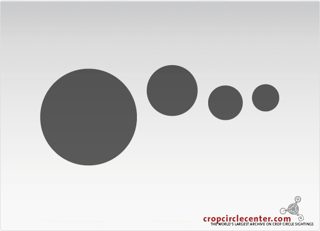
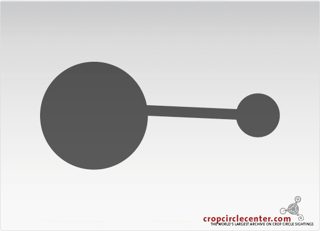
Member by member
| formation | date | place | county | crop | site | elements | rings | rotational | mirror | stored size |
|---|---|---|---|---|---|---|---|---|---|---|
| Biches FR20120629_A | 29 June 2012 | Biches | wheat | cc | 4 | 1 | none found | 0.93 | 575×415 | |
| Wakerly US19980626_B | 26 June 1998 | Wakerly | cc | 1 | 1 | none found | 0.98 | 575×415 |
The element count is right to within one on 97.5 % of a 161-diagram hand-labelled sample; the rotational order right on 88.8 % of a 197-diagram hand-labelled sample, against a gate of 90 %; the ring count agrees with a reader on 35.9 % — it is not a calibrated number.